
Modular Data Center Cooling: 4 Key Configurations
Date:2026-11-03As digital infrastructure continues to expand, modular data centers are becoming an attractive option for businesses that require flexible deployment, predictable scalability, and efficient infrastructure integration. However, cooling performance depends not only on the cooling equipment itself but also on how air moves through server racks and how heat is managed across the entire facility.
SHENGLIN explores four common cooling configurations for modular data centers: cold aisle containment with in-row cooling, hot aisle containment with in-row cooling, cold aisle containment with room cooling, and hot aisle containment with room cooling. Each configuration offers different advantages depending on rack density, spatial layout, and operating requirements.
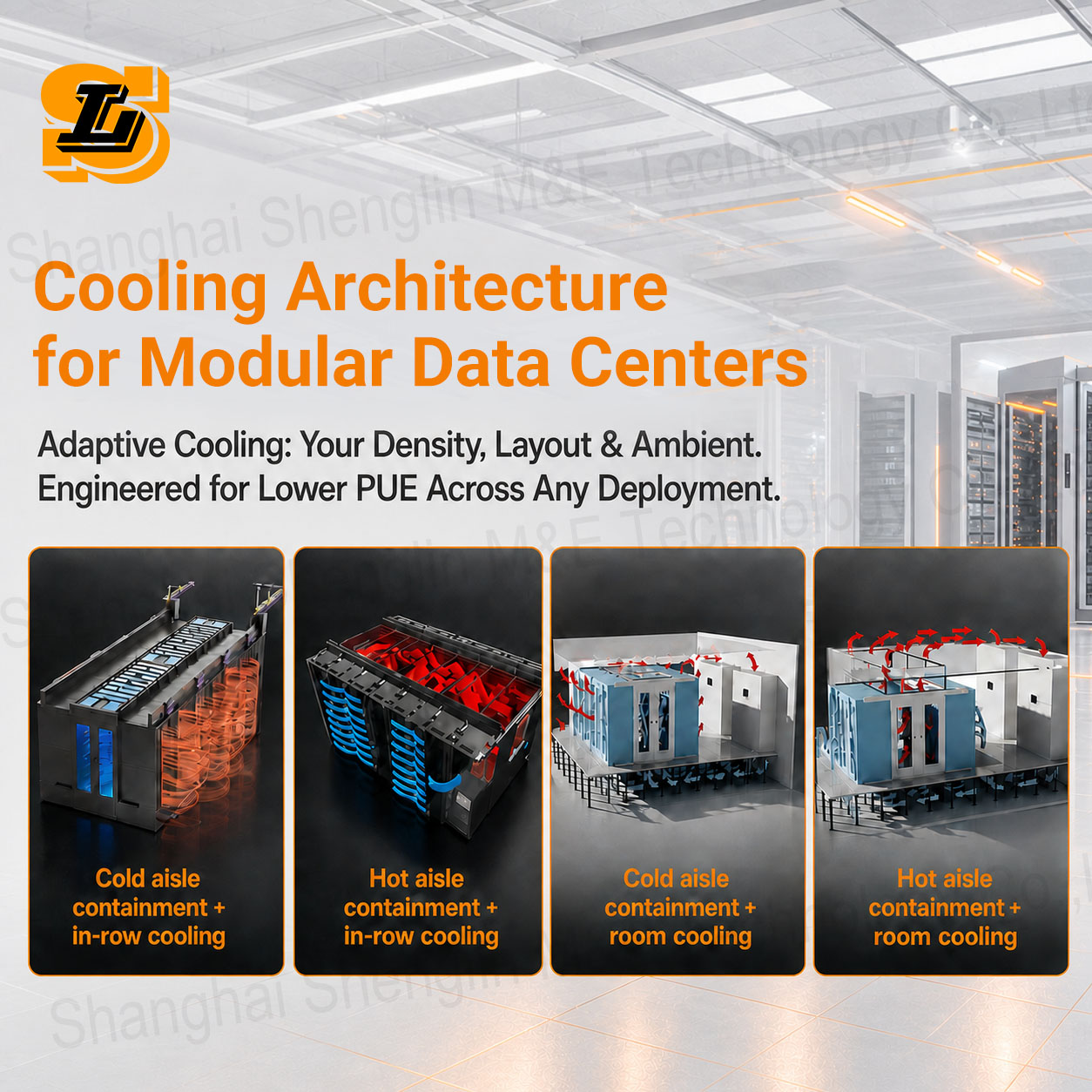
1. Cold Aisle Containment + In-Row Cooling
Cold aisle containment encloses the space between the front faces of opposing server racks, keeping the cold air supply concentrated around server air intakes. In-row cooling units are installed directly within the rack rows, bringing cooling capacity closer to the IT equipment.
This configuration helps reduce the mixing of cold supply air and hot exhaust air while providing localized temperature control. It is particularly suitable for modular data centers with relatively high rack densities or limited floor space, where targeted cooling and effective airflow management are important.
2. Hot Aisle Containment + In-Row Cooling
Hot aisle containment encloses the rear sides of opposing server racks, capturing hot exhaust air before it disperses into the surrounding space. In-row cooling units can draw in heated air, remove the heat, and deliver conditioned air back toward the server intakes.
This arrangement supports more controlled heat removal and can be beneficial for high-density IT deployments. By managing hot air close to its source, operators can reduce unwanted air recirculation and improve the consistency of cooling performance across the rack rows.
3. Cold Aisle Containment + Room Cooling
Room cooling uses cooling units positioned around the data hall or in designated mechanical areas to supply conditioned air to the server racks. Cold aisle containment creates an enclosed zone around the server air intakes, helping ensure that cool supply air reaches the equipment more effectively.
This configuration can be suitable for modular data centers with moderate heat loads and a centralized cooling layout. Its performance depends on appropriate cooling unit placement, sufficient airflow, and effective air distribution throughout the room.
4. Hot Aisle Containment + Room Cooling
In this configuration, room-level cooling equipment supplies conditioned air to the IT space, while hot aisle containment collects server exhaust air within an enclosed aisle. The captured hot air can then be directed toward designated return paths for cooling.
Separating hot and cold airflow helps limit heat recirculation and supports more predictable thermal conditions. This approach can be considered for modular data centers that require organized airflow management while retaining a room-level cooling arrangement.
Key Factors in Selecting a Cooling Architecture
Choosing the right cooling configuration requires a comprehensive assessment of several factors:
(1)Rack density: Higher heat loads may require cooling equipment positioned closer to the servers.
(2)Space constraints: Compact modular layouts may benefit from in-row cooling and carefully designed containment.
(3)Airflow management: Effective separation of supply and return air helps reduce bypass airflow and hot spots.
(4)Scalability: Modular cooling systems should accommodate future IT expansion and changing rack loads.
(5)Energy efficiency: Proper equipment selection, airflow optimization, and control strategies can help reduce cooling energy consumption and improve Power Usage Effectiveness .
No single configuration is ideal for every deployment. The most appropriate solution depends on the IT load, facility layout, environmental conditions, and operational priorities.
SHENGLIN supports modular data center projects with integrated infrastructure and application-oriented cooling solutions. By aligning cooling architecture with actual deployment requirements, data center operators can establish a more adaptable thermal management strategy for current operations and future growth.


- 01 Feb,2024Dry Cooler D4-8x910 In Stock Is On Sale! Discount!
- 06 Sep,2023Pad Adiabatic Dry Cooler Trial Operation Before Shipment
- 06 Sep,2023828kW Adiabatic Cooling System Dry Cooler Loading
- 17 Aug,2022Flat Type Dry Cooler Finished For Canada Client
- 06 Sep,20231061kW dry cooler loading for USA client
- 31 Mar,2021Peru client Install Shenglin Adiabatic Dry Cooler At Site